The proliferation of eCommerce has revolutionized the retail industry. With the consumerization of technology, the entire world has turned into a marketplace that is easily accessible for both, businesses, and consumers. As a result of this change, a number of eCommerce platforms have emerged and are now powering millions of eCommerce websites around the globe.
As the internet has become more accessible and our phones have turned smarter, it has opened many new avenues for businesses. In fact, many online stores are making huge profits by catering to both website and app-friendly shoppers. It is also noteworthy that with many tools such as DIY website builders and DIY app makers available online, businesses have become more accomplished.
However, before you proceed to enter the app market, you should establish your eCommerce store. With multiple options available online, it might be tough for you to choose the best platform to start. To address this dilemma, we will guide you through a comparative analysis of WooCommerce and Shopify, the two leading eCommerce platforms. Stay tuned and find out the most suitable one for your business.
In this blog
- WooCommerce and Shopify: An introduction to the basics
- The ten parameters that determine your convenience
- TL; DR: An overview of the comparison
- WooCommerce vs Shopify: Detailed feature comparison
WooCommerce and Shopify: An introduction to the basics
There are a range of eCommerce platforms that cater to businesses that are aspiring to flourish in the online market. The industry includes many names like WooCommerce, Magento, Shopify, BigCommerce, Wix, etc. However, today we will discuss arguably the two most popular platforms, i.e., WooCommerce and Shopify. We have chosen these two names for our comparative study for a variety of reasons.
These two platforms, despite having some very distinct qualities, are quite esteemed and similar in their essence. Let us go through a basic introduction of the two, before analyzing various aspects in detail.
WooCommerce: The power of open source
WooCommerce is actually an eCommerce extension of the most popular platform, WordPress. As an open-source plugin, it empowers eCommerce websites that are built on WordPress. This is one of the simplest and most affordable solutions that appeals to all scales of businesses alike.
WooCommerce is quite new, but it has managed to attract the maximum eyeballs in a concise period of time. According to statistics, it has the strongest lead among other eCommerce platforms and holds the first place with 29% market share and 1,972,353 registered domains.
It comes with the WordPress assurance and a flexible architecture where almost any of your eCommerce goals can be fulfilled with added plugins, themes, functionalities, etc. The additional functionalities are not tied to plans and the platform users can enjoy absolute freedom.
Shopify: The luxury suite of services
Shopify emerged in Canada, and over the years, it has been constantly evolving and expanding. This holistic retail point of sale and eCommerce solution is now spread across more than 170 countries. It holds a market share of 10.28% with 611,876 registered domains.
The suite of services available under one roof, provide a luxury experience. Hence, Shopify, along with its advanced solution Shopify Plus has become the ultimate platform for niche businesses and brands.
It bundles several features and functionalities that otherwise rely on third-party solutions on WooCommerce and presents it all to the users in one packaging. The Shopify store has thousands of apps for merchants that make it easier for them to set up and manage their store.
The ten parameters that determine your convenience
When it comes to comparisons, it is important to identify the right parameters. The same goes for eCommerce. There are several factors and parameters, that determine the quality and goodness of an eCommerce platform. In order to make the most of your resources and choose the best for your business, you must know where the platform stands on these parameters.
This may include the following:
- Pricing, budget, and payment
- Ease of use and build-time
- Support for design and performance
- Customizability & Scalability
- Added list of features & benefits
- SEO (Search Engine Optimization) support
- Security provisions
- Customer Support
- Overall pros and cons
These parameters can determine the value that the eCommerce platform has to offer. How easily and effectively you set up, run, manage, and grow your store, will ultimately depend upon these parameters.
Let us start the comparative study of the core factors of WooCommerce and Shopify and know more. Explore all the details and how the two giants compare against each other. You can also first get an overview of the comparison at a glance in the TL; DR section below.
TL; DR: An overview of the comparison
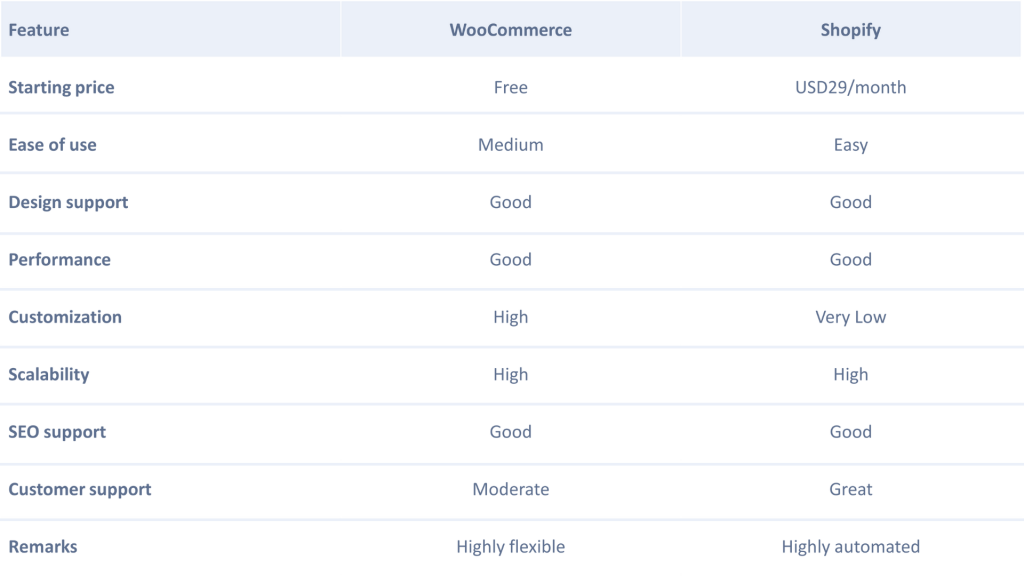
Need a quick run through? Go through the table below and get an overview of comparison between WooCommerce and Shopify, and know how each of them perform on various parameters:
Related Read: Checkout our blogs on the market share of WordPress and Shopify and learn about the extent and popularity of the two eCommerce CMS platforms.
WooCommerce vs Shopify: Detailed feature comparison
It is not enough to get into the nitty-gritty details of all the pros and cons by just looking at an overview as both the platforms are quite nuanced. So, let us go through the comparison in detail and know more:
#1- Budget and Payment
WooCommerce
The best thing about WooCommerce is that its base product is absolutely free. However, as you proceed to integrate advanced features and plugins, the budget keeps increasing exponentially.
When creating a website with WordPress for setting up WooCommerce, you will have to purchase hosting and domain name, SSL certification and other extensions separately. However, since it is a competitive market, you can look for hosting service providers like WP Engine or Blue Host, that offer these services under one roof, at optimal prices.
Shopify
Shopify, unlike WooCommerce, has more rigid and fixed pricing plans. The plans range from USD 29 per month to USD 300 per month. Once you have chosen your plan and subscription, your billing cycle is bound to reflect the same amount every time.
Unlike WooCommerce that is self-hosted, Shopify hosts and manages the software for you, so you don’t need to purchase a separate hosting package. This reduces the burden of additional expenses and as you proceed to purchase more advance plans, the benefits also increase.
Conclusion
WooCommerce is the absolute winner if you are looking for basic features that come for free. Besides, unlike Shopify that charges 2% per transaction for using third party gateways for customer payments, WooCommerce only has integration charges.
You will also save on commissions as the cost of processing each transaction on your WooCommerce website may totally depend upon the payment gateway service providers or plugins that you use. However, Shopify can be a better option for you if you are looking for consistent pricing plans and ease of regular payment cycles.
#2- Build-time and ease
WooCommerce
Working with WooCommerce is like entering into a store, buying all your ingredients, and then preparing the meal on your own. It certainly offers you a sense of accomplishment alongside flexibility, but also demands extra time and effort. However, Shopify is like a takeaway order.
Yes, you read that right. WooCommerce consumes more time and requires more effort as compared to Shopify. If you want technical control and are ready to deal with the nuances, it is best. However, you will have to start by building a WordPress website and then take care of most of the technical aspects yourself.
The good part is that WooCommerce comes with a setup wizard that guides you through the initial setup and helps you accomplish tasks like adding payment gateway, choosing your currency, and selecting your shipping methods.
There is a learning curve but a great number of blogs and tutorials come in handy to help you achieve the desired results. Additionally, with a wide range of theme support, you get the power to highly customize your website and that is unmatchable.
Shopify
If you are not very tech savvy, or you wish to invest little effort and time, then Shopify is the best for you. It is the perfect ensemble of ready to use tools that make the journey easier. The platform does all the heavy lifting for you so that you don’t have to.
It is highly beginner-friendly, and you can get started with this platform in no time. Unlike WooCommerce, you do not have to start everything from scratch and a lot of the processes are automated.
Shopify is also self-hosted and thus relieves you of the task of finding hosting service providers. You also do not need to install, manage, or update any software and it is comparatively easier to amend different elements when you create a website with Shopify.
However, as most of the things are pre-fed or managed by the service providers, you might feel the lack of control over your online store. This can also affect your overall design and functionality related decisions.
Conclusion
Shopify is a clear winner when it comes to ease of building and time. However, if you want to invest yourself in the process and take control of it, then go for WooCommerce.
#3- Design and Performance
WooCommerce
The quality of design often has a direct impact on the performance of the website however not everyone is a designer or developer out there. Fortunately, WooCommerce comes with endless theme and design support and the options are extensive.
You can put up an elegant store based on your design preferences. It has several theme marketplaces and a huge directory of plugins that can help you optimize your store for speed and performance.
It can also ensure a satisfactory load time and speed, for both desktops and mobile devices. Additionally, WordPress is being constantly optimized to become more mobile-friendly, thereby benefiting WooCommerce customers as well.
All in all, you can get the freedom of design and development and create a beautiful and powerful website with WooCommerce. You can choose from endless options and set up a store that carries your brand identity.
Shopify
Shopify, as compared to WooCommerce, has limited options when it comes to themes and layouts to choose from. The ability to customize the designs is also comparatively low and thus it may infuriate those who are fussy about control.
However, it has the perfect platter of the choicest themes that have been filtered overtime. It has many sleek and elegant templates that help you narrow down your options and make easy design choices for your website.
Additionally, Shopify comes with an intuitive drag and drop interface. This makes managing your product pages, sales, and inventory inside Shopify a breeze. Besides, the performance of Shopify can turn out to be better, as far as the load time and speed is concerned.
One downside of this guided, chiseled, and highly optimized user experience is that it limits your control. You can only use the design and development tools provided by Shopify or add-ons available in their marketplace.
However, this is not as bad as it sounds. For most users, the large selection of extensions and themes available in Shopify is more than enough to get started and grow their online store.
Conclusion
While WooCommerce excels in the theme and design section when it comes to options, Shopify is a winner in the performance sector. However, the differences are very fine, and the competition is really close. Plus, with the right plugins and extensions, you can enhance the performance of your WooCommerce website to unimaginable scales.
#4- Customizability
WooCommerce
As discussed above, WooCommerce is a highly customizable platform that is easy to install, configure and maintain. If you are aware of WordPress, it can become easier and smoother for you. Though managing several aspects like hosting, security, maintenance, etc., can become a task, you get absolute control over the website.
Also, it comes with hundreds of additional extensions to choose from, and these added benefits let you take complete control of your website’s design and functionality.
While you may not be able to pick random features out of the box, you will also not have to rely on the platform’s own templates, fixed structures, and functionalities. You can create a list of your own features and build bespoke websites that truly reflect you and your brand.
Shopify
Shopify brings ease and comfort to the table. Most of the work is handled automatically and you get to work in a drag and drop like environment thereby making the platform beginner-friendly and suitable for the less tech-savvy lot.
However, since there is less manual interference, there is also less scope for change. As a result, Shopify lags behind WooCommerce when it comes to customizability. Unlike WooCommerce, it does not come with hundreds of added plugins, themes, functionalities, etc.
However, you can still go for it if you do not wish to optimize your website more often. Furthermore, Shopify also comes with built-in multi-channel integrations that lets you sell on several social media platforms and grow beyond your website.
Conclusion
Clearly and undoubtedly, WooCommerce gets a strong edge over Shopify when it comes to customizability.
#5- Scalability
WooCommerce
The scope of parallel growth of your website, as your business grows, determines its scalability. Growth brings in new challenges to deal with and your eCommerce platform must be ready to take on those challenges and help you grow without any friction.
As WooCommerce is highly customizable, you can easily adapt it to the growth and expansion of your business and consumer traffic. You can upgrade specific resources, add more functionalities, use added plugins and extensions, and more, to match your growing demands.
However, you may have to deal with third parties like plugins and hosting service providers, among others, to ensure that all their services align with your growth. This may come with added challenges and hindrances but can be dealt with easily as WooCommerce is a part of the highly active, widespread, and volatile WordPress ecosystem.
Shopify
Shopify also allows advanced plans that suit your need of scalability. As most of the things are managed by Shopify itself, you also get to shed the workload. It means that you can adapt to the growth without making too much extra effort.
However, this may require you to sign up for costlier plans and affect your budget. If you are ready to face that and are fine with letting go of the absolute control of your website, you can definitely go with Shopify. It also has enterprise services that are best suited for large-scale businesses.
Basically, the platform is capable of handling your growing demands and needs and the infrastructure can easily deal with several nuances that are a part and parcel of website management. This includes handling downtime, managing backups, pushing updates, or ensuring security.
Conclusion
Both the platforms are scalable and can be optimized to suit the growth of your business. For automated processes, you can select Shopify, and for customizable alternatives you can go for WooCommerce.
Suggested Read: Selling on platforms like Amazon vs setting up your own online store
#6- Extended Features
WooCommerce
Extended features such as payment gateway integrations, social media integration, lead generation, analytical support, email marketing support, drop shipping support etc., are highly and easily accessible on WooCommerce. These features leverage the performance of the site and strengthen it further.
WooCommerce has a low barrier to entry and an endless list of integrations that you can harness. This number is far bigger than what Shopify has to offer. In fact, there are endless options available out there that can help you create a wholesome eCommerce website.
Almost every imaginable feature that you can think of, can be made live on your WooCommerce store with the right plugins and integrations. Therefore, you can do a lot more than just sell product and go holistically as a brand.
Shopify
Shopify, though less flexible, comes with a range of add on features that provide the extra mileage and support. Both free & paid add-ons, and extended tools are available on the Shopify store that can be included as a part of your subscription.
While the number of options available is less than what WooCommerce has to offer, you still have enough that you can work with. Additionally, Shopify comes with hundreds of apps that make it easier to achieve diverse business goals.
Merchants can download these apps and manage their store with minimal effort. You can also look for apps to support additional features like social media integration, lead generation, analytical support, email marketing support addons, drop shipping support, and more.
Conclusion
Both the platforms provide ample extended support that can enhance the functionalities of your site. However, it is easier to integrate customized features and plugins on WooCommerce.
#7- SEO Support
WooCommerce
SEO (Search Engine optimization) determines the ranking and visibility of your website. WooCommerce has a better and more direct infrastructure when it comes to offering SEO support. This gets backed by a robust WordPress ecosystem that further levels up the game.
As you get manual control over the entire site on WooCommerce, you upload most of the data yourself. This includes product meta data and site information where you can use keywords. As a result, you get added benefits of SEO. You can also use the tools meant for this purpose.
In fact, there are several plugins and extensions like All in One SEO or Yoast SEO available out there that can help you enhance your website’s performance and ranking. You can leverage these dedicated services and power your SEO endeavors.
Shopify
In the long run, Shopify’s SEO support may seem restrictive and limited as it only has a few apps to offer. As the platform is highly automated, you cannot feed in much customized data that can help you with the SEO optimization.
However, the SEO amplification plugins, smart and SEO friendly system, and viable tools can help you master this part without much hassle. Websites built on Shopify can earn good rankings and get as much exposure for your brand.
Just like WooCommerce, you can add descriptions and titles for your images, products, and pages on Shopify that can help search engines identify your assets without much hassle.
Conclusion
SEO plays a significant role in driving traffic for your website. Considering this factor, we can say that the optimized SEO support from WooCommerce can help you rank higher on the search engines. However, Shopify has SEO tool extensions that can do the same for you.
#8- Security
WooCommerce
Security, significant compliances, smooth performance and running, etc., are some of the aspects of having a website that must be taken seriously. If you do not have a hosting or security provider to take care of these things, then you will have to handle them yourself on WordPress.
In fact, the security aspects of the website need to be taken care of manually for WooCommerce. If you host the domain yourself, you are primarily responsible for SSL certification, configuration of site security plugins and two-factor authentication, PCI-DSS (Payment Card Industry Data Security Standard) Compliance, etc.
These things can get tricky for a less tech-savvy person. While there are several plugins and services available out there, you still cannot be totally relieved of the responsibility of ensuring the security and performance of your website when it comes to WooCommerce.
Shopify
Shopify is one the safest solutions as it already comes with SSL certification and PCI-DSS Compliance. Most of the security aspects are managed by Shopify itself which ensures a sense of safety. In fact, we can say that Shopify takes care of your website’s security for you.
While this may eliminate control, it also reduces accountability and responsibilities. Shopify handles security certifications and compliances and also takes care of updates, backups, etc. The robust infrastructure ensures that your website runs smoothly and loads with minimal friction.
Additionally, as discussed above, Shopify’s infrastructure runs on servers that are Level 1 PCI compliant which is a mandatory requirement for accepting credit card and debit card details. All the data transfer is also encrypted and thus the platform paves the way for safer, secure and more robust experience.
Conclusion
Clearly, Shopify stands as the winner when it comes to the security aspect of your eCommerce websites. It is noteworthy that Google gives a special preference to websites that are safe and secure.
Suggested Read: What is an SSL certificate and why is it important for your website?
#9- Support
WooCommerce
Over the years, WooCommerce has become more user-friendly and simpler to use. Additionally, as stated in the sections above, WooCommerce takes a more individual approach when it comes to managing and handling the nuances of the website.
There isn’t much one-on-one customer support, except the help sections and community forums when it comes to WooCommerce. However, there are many self-help resources when it comes to resolving queries, overcoming bottlenecks, or getting the right direction.
There is also extensive documentation by WooCommerce that can help you with everything from installation to managing orders and running your store. Moreover, there is a huge community of WordPress and WooCommerce experts and multiple forums where you can seek help whenever you need it.
Shopify
Shopify has a winning and unparalleled approach when it comes to thorough and extensive consumer support. You get to communicate directly with the support team and experts through a round-the-clock-set up.
In fact, many believe that Shopify offers the best support in the industry. It extends 24×7 live chat, email and phone support alongside detailed tutorials and guides. Other than that, it also has an extensive ban of FAQs and tutorials that come handy at the time of need.
Shopify also has a forum where you can interact with the community of merchants and experts and get answers to your queries or help others. Basically, Shopify ensures a 360-degree approach when it comes to offering support to its customers.
Conclusion
Evidently, there isn’t much to debate, and Shopify can be declared as the winner hands-down when it comes to customer support. In fact, it is one of the best and finest in the industry.
#10- Overall Experience
WooCommerce
As WooCommerce accounts for a major share in the marketplace, we can say that it is a tool meant for the masses. Its simplistic appeal and the robust partnership with WordPress, makes it a great choice for all businesses, big and small.
Shopify
The market share and popularity of Shopify is rapidly growing. If you are willing to invest money, instead of efforts and time, it can be a great option for you. It is best for businesses that seek more wholesome and luxury solutions, most of which are automated.
Conclusion
Shopify and WooCommerce are quite different from each other and yet stand in close contest on almost every aspect. Both the platforms have their own charm and offer a distinct bouquet of benefits.
Depending on your business goals, resources, and plan of action, you can choose either of the two eCommerce platforms to set up your online business.
Whatever your choice is, we have you covered!
That was all! You should be more aware of the core aspects of WooCommerce and Shopify. These two eCommerce platforms have their own charm and suit the needs of various businesses differently. If you wish to make your mark in the eCommerce realm, the first step is to set up your online business by creating a WooCommerce website or a Shopify store. Once you have accomplished this, you can also venture into mCommerce and ensure roundabout success.
You can build an app with AppMySite that enables you to create premium native apps for any website whether WordPress, WooCommerce, Shopify or any other. You can make your own apps instantly, effortlessly, and affordably. So, if your choice is WooCommerce then get a website and proceed to build Android & iOS apps for WooCommerce without coding, or create one for Shopify. Offer a 360-degree solution to your clientele and become the go-to source for all their retail needs.
While you are here, do not forget to explore our other blogs and read on a range of topics like website and app maintenance, app development, online marketing, and much more. Let us know if you want us to cover anything specific of your choice in the comment section below!