
Do you open your Firebase dashboard every morning to check how many downloads the previous day?
As the dashboard loads, do you ever wish the downloads went up magically?
Do you hope your app has finally made it?
Magic really has no place in the mobile app market.
It takes months and years of hard work to create, publish, and market a successful mobile app.
Many entrepreneurs wade into the world of mobile apps with a big vision and a bag full of ideas.
There is no need to point out the percentage of those who end up failing.
Instead, the interesting part lies in covering how the ones who found success made it.
The wrong (and commonly held) perception of app growth
This is how many budding entrepreneurs think apps grow and become successful.
1. Make the app
2. Take it to market
3. People will automatically see its great features and inherent value
4. App will be successful (and be given an arbitrary billion dollar evaluation)
This is the popular prevailing notion many believe in. It is not just restricted to mobile apps. People with ideas for starting a business or making a product also subscribe to similar notions.
Like many notions born from wishful thinking, these are also delusions at best.
In reality, the path to app growth and success is much more complex. Apps in different sectors end up following a different route.
Generally, it’s the growth trajectory that remains the same. Successful apps amass downloads and manage to keep hold of their users. Furthermore, they manage to keep improving their app while finding unique ways to promote it. Anyone running a successful WooCommerce Android app would attest to the same.
In the following section, we will cover how app growth generally happens through a concept called technology adoption life cycle.
The technology adoption life cycle
The technology adoption life cycle is a way of understanding how people react and accept a new technology in the market. It is a sociological model that became popular in the late twentieth century when the world was being transformed by rapid technological changes.
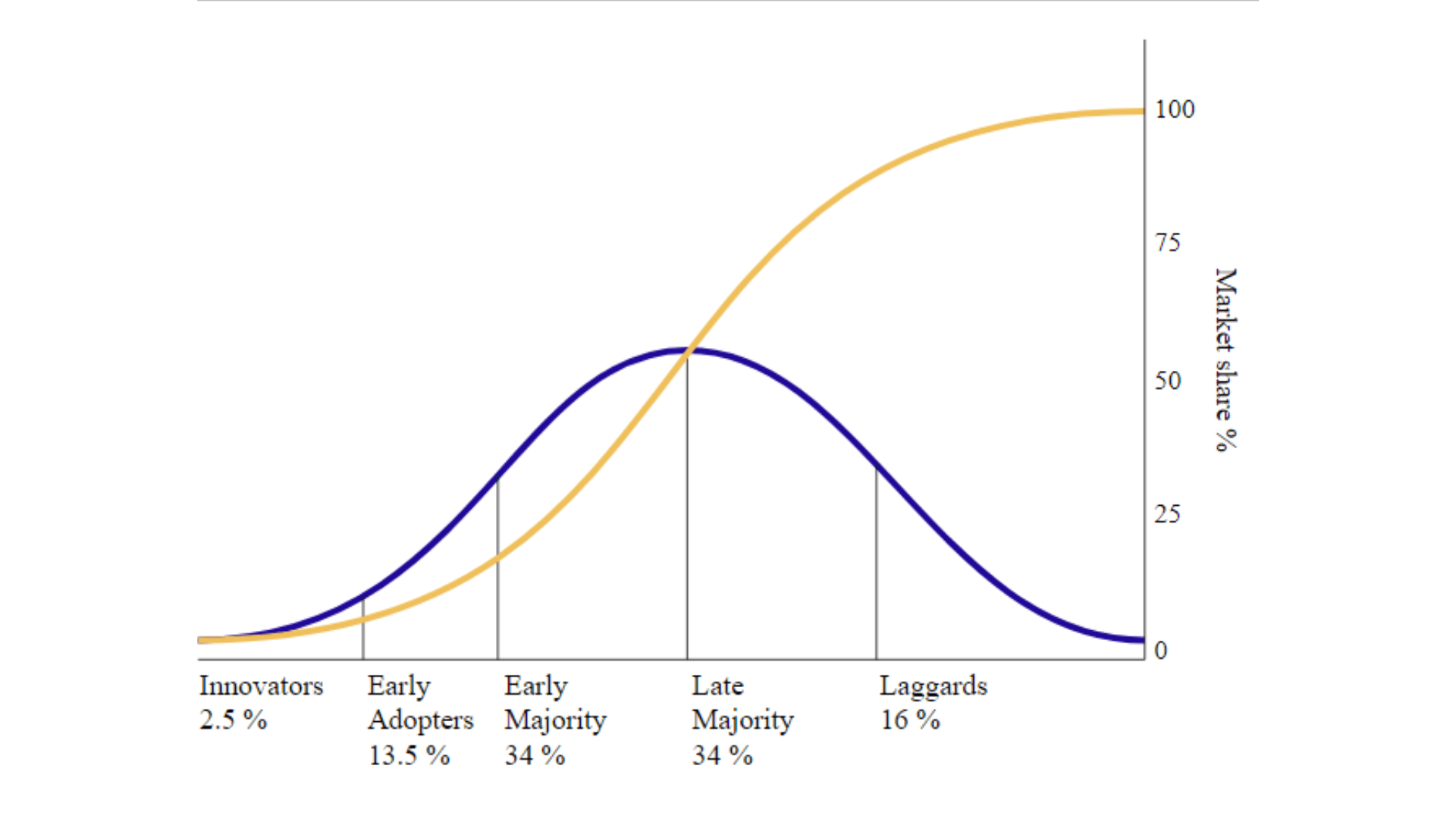
The curve here divides people based on how they adopt any new product or technology in the market.
As the curve shows, every type of adopter starts using a new product or technology at a different stage.
The rightmost point on the horizontal axis represents the point where the market share of a product is 100%. This is the point of product saturation.
How does this translate to app growth?
Mobile apps are the most predominant mediums today to bring forth a new product or technology. This is because of their sheer ubiquity across every demographic.
Just as people don’t readily accept a new technology, people don’t just start using a new app either. The growth trajectory of an app resembles the cycle depicted earlier.
When this life cycle was first theorized, adopter group attributes were based on sociological factors.
In the following sections, we will discuss the characteristics of each adopter group in the context of the mobile app market.
Innovators
In the context of mobile apps, innovators refer to people who are risk takers. They are always willing to give new apps a chance.
Generally, innovators are people who’ve spent a lot of their life working with technology. They back their judgement on any new app and never shy away from trying out a new technology.
Innovators are also those who belong to the same domain the app does. For example, a game developer is more likely to try out new gaming apps to get an idea about where the industry is. Innovators are generally people who’re always on the lookout for new apps.
The first order of business for any new startup with an app in the market must be to target innovators. This is because innovators are much more likely to adopt the new app.
For anyone going from WordPress to Android app, targeting innovators is necessary to give the app the push it needs.
We will cover how these adopters can be targeted specifically in the forthcoming sections.
Early adopters
Early adopters share many characteristics with innovators. They are willing to take a bet on new mobile apps because of their risk-taking nature.
In the domain of mobile apps, innovators and early adopter groups overlap a lot. They are similar in age and their approach towards technology.
Take Facebook as an example. The people who first popularized the platform were tech-abled college students who were far ahead of the general population in their understanding of the internet.
If Facebook had tried to simplify its platform to reach a more general audience, it would have failed. This is because it would have then been typecast as another small fish in a large pond. However, it managed to overcome its user experience and design issues with early adopters and transitioned into becoming a more general platform.
As an app goes through the innovator and early adopter stage, its market share rises to 15-20%. This is the stage where an app can either break out or remain on the fringes.
Breaking out is not just a matter of marketing and investment. Companies have to react to the user behaviour and app development trends of their existing user base. This is the stage where developers need to create an app that is ready to break its ceiling and capture the market.
You have to find a way to target early adopter groups after you build your own app.
Early majority
While early majority groups are not as exposed to technology or open to taking risks as early adopters, they do have the power to shape widespread opinion.
A good example of early majority groups are news media professionals.
Early majority groups are generally people who remain in contact with early adopters. Any new mobile app or product popular amongst early adopters quickly becomes a trend amongst early majority groups.
According to the technology adoption cycle, early majority users hold the reins over opinion leadership. They are not as technologically proficient or financially secure as early adopter groups. However, their hold over general opinion can skyrocket growth.
The peak of an app’s growth comes when an early majority shores up its market share. An app can control as much as 50% of the market share as early majority groups peaks.
Late majority
Late majority groups cover the sceptics. These people do not react well to new changes in technology. While they remain in contact with early majority groups, they have much lower control over opinion leadership.
They are generally risk averse and only embrace something new after an average person has done the same. In the context of the mobile app market, late majority groups contain users who are satisfied with their mobile app usage and only shift to a new app after someone they know does the same.
Since late majority users mostly remain in contact with people similar to them, it is difficult for a company to get through to them. Someone going from WordPress to Android app will naturally face such a problem when marketing the app.
Laggards
Laggards are the people who accept a new technology after there is no other option.
For instance, many people who used conventional cell phones until a few years ago finally switched to smartphones. This is because most communication began happening over the internet and conventional phones were no longer a viable option.
If you’re trying to build your own app, the one app marketing mistake you must avoid is targeting laggards. Many entrepreneurs think they can find customers where no one else can. This leads them to targeting laggards. A hubris like this can single handedly guarantee the app’s failure.
Laggards generally accept an app on their own. They are forced to move and accept a new technology. Companies don’t really need to promote their app to them.
How should adopter groups affect app growth strategy?
Most companies follow a codified path to develop an app. This simply means they do not look too far ahead in the future while developing an app. The natural course of action is developing a MVP version of an app, putting together a marketing campaign, and beginning work on optimizing key app metrics.
A more strategic approach is accounting for the specific attributes of the adopter groups who will first use the app.
If an app doesn’t manage to make an impact on innovators and early adopters, it will not break its market share ceiling.
Think of bringing an app to market like a level-based game. You may have the skills to cross level three, but you must first learn how to pass levels one and two.
The following sections discuss how adopter groups affect three major parts of an app cycle.
#1- App development
There are two distinct ways developers can go wrong during app development –
a. Focus too much on perfecting the app
Let’s say you develop a banking app. Your app solves a core issue normal users face while banking on their mobile phones.
The selling point of your app is the core problem it is solving. The focus of the development team should solely be on perfecting the selling point.
App development often devolves into low stakes side quests that don’t exactly address the core issue an app is solving.
Complete perfection is impossible, especially when bringing an app to market for the first time. There is not enough to perfect every little part of the app.
This is why developers create a minimum viable product (MVP) version of their mobile app. An MVP version offers the core solution an app is bringing.
The interesting question here is – will innovators and early adopters like such an app? The answer is yes. These adopter groups typically understand the potential of a new app despite a few flaws.
Creating an app for late majority and laggard adopter groups when coming to market for the first time is futile. Reaching that level requires a lot of user behaviour and experience analysis that only comes with live data.
b. Bringing an inadequate app to market
Sometimes companies bring a less adequate version of an app to market. This typically happens when there is too much trust in the solution an app is offering.
What is an inadequate version of an app? An app that presents the core solution of an app in an unsatisfactory manner is an inadequate solution.
Let’s say you have an idea to develop the Netflix for books. You offer app users access to all new books at a fixed subscription rate.
What is the primary activity of users on your app? Reading.
If the part of your app where people read books is poor, you will not have any sustained growth. The same is true if you’re bringing a WooCommerce android app to market. In such a case, you need to make sure the purchase and checkout process is as smooth as possible.
You need to ensure the core functionality of your app is operational when it comes to market. Imagine if Amazon had a difficult checkout process or Google made it tedious for people to search for something. Would they survive the initial batch of adopters?
#2- App marketing
The technology adoption life cycle brings very interesting solutions for app marketers.
How does app marketing usually work? Let’s say a company brings an app to market. The general rule of thumb is running traditional marketing campaigns. These campaigns generally involve growing presence across various social and search platforms.
Does this strategy work? Yes. Bringing the technology adoption cycle can enhance the process though.
A new app always struggles to get any traction in the beginning stages of a marketing campaign. At such a stage, marketing it to innovators and early adopters makes a lot of sense.
Where can marketers find such people?
Finding early stage adopters requires marketers to think beyond digital marketing conventions. They are generally found on niche forums where discussions on select topics are very active. Think of small and highly engaging subreddits.
These channels generally have people who are passionate about a particular topic and always engage. They represent the grassroots of any given market segment. Bringing your app to such an audience can give it the initial base of users it needs to cross the early market share threshold.
#3- App analytics
The adoption cycle ideally changes the way analysts study crucial data. This is because they have to view incoming users as customers who belong to different adopter groups.
The standard analytics for an early adopter would differ greatly from someone who downloads an app as a late majority adopter. Differences in attributes can play out dramatically in the overall app data.
App analysts are also supposed to help developers and marketers understand the adopter group they must work towards. Using existing data on different adopter groups of a particular domain, analysts can help both developers and marketers reach a certain standard. This is crucial for the long-term growth of an app. The use of the right mobile app analytics tools is also crucial in this process.
In Conclusion
App growth is always a dicey topic. Every manual out there prescribes a whole set of strategies and techniques to grow app users. The explosion of growth hacking in the startup domain is an example of the same.
This piece tries to look at app growth from a more long-term perspective. When an app comes to market, its only real ceiling is achieving 100% market share. However, the path is never straightforward and brings a lot of different factors into consideration.
Using the technology adoption life cycle, entrepreneurs can map their app growth. It also brings perspective to the life cycle of an app and its market share.